- English
- Español
- Português
- русский
- Français
- 日本語
- Deutsch
- tiếng Việt
- Italiano
- Nederlands
- ภาษาไทย
- Polski
- 한국어
- Svenska
- magyar
- Malay
- বাংলা ভাষার
- Dansk
- Suomi
- हिन्दी
- Pilipino
- Türkçe
- Gaeilge
- العربية
- Indonesia
- Norsk
- تمل
- český
- ελληνικά
- український
- Javanese
- فارسی
- தமிழ்
- తెలుగు
- नेपाली
- Burmese
- български
- ລາວ
- Latine
- Қазақша
- Euskal
- Azərbaycan
- Slovenský jazyk
- Македонски
- Lietuvos
- Eesti Keel
- Română
- Slovenski
- मराठी
- Srpski језик

PS Sheet Extrusion Line: Common Production Problems and Practical Solutions for Stable Sheet Quality
Polystyrene (PS) sheet extrusion lines are widely used in the plastics processing industry, but in actual production, every stage—from raw material preparation to winding—can present issues that affect quality and efficiency. This article examines common faults, their root causes, and practical countermeasures based on frontline operating experience, helping production teams diagnose problems quickly and optimize processes effectively.
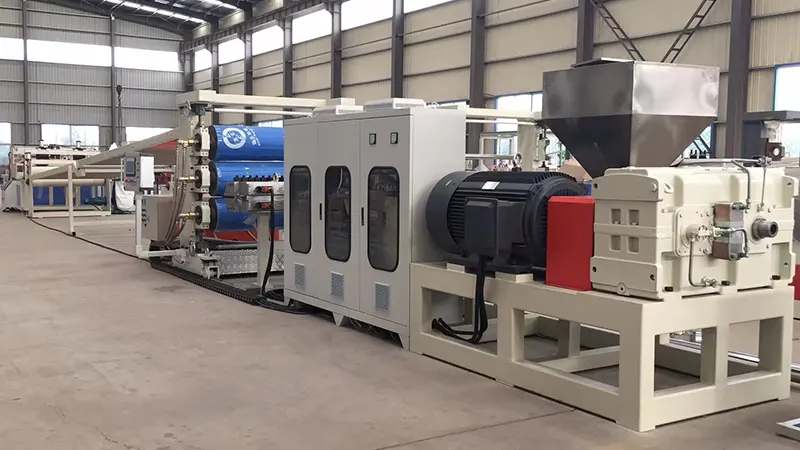
1. Raw Material Preparation: Practical Considerations
Problem 1: Silver streaks or bubbles on the sheet surface
This is a classic sign of excessive moisture. PS is mildly hygroscopic; even small amounts of moisture will vaporize at melt temperatures, causing silver marks on the surface or internal bubbles in the finished sheet.
Solutions:
-
Ensure the drying system is functioning properly. Recommended drying conditions: 75–80°C for 2–3 hours.
-
When restarting after a shutdown, purge the first portion of melt to prevent moisture-contaminated material from entering the die.
-
In humid seasons, extend drying time and monitor moisture content regularly. Target moisture level should be below 0.05%.
Problem 2: Degraded mechanical properties from excessive regrind usage
Using edge trim and scrap is an effective cost-saving measure, but regrind undergoes thermal degradation with each processing cycle, leading to chain scission. This results in brittle sheets with reduced impact strength.
Solutions:
-
Keep regrind content between 15% and 25%, adjusting based on product requirements. For high-clarity transparent sheets, reduce the proportion further or avoid regrind entirely.
-
Dry and de-dust regrind thoroughly before use to prevent contamination.
-
Consider adding impact modifiers to compensate for the loss of toughness caused by regrind.
2. Extrusion Section: Common Issues and Adjustments
Problem 3: Output fluctuation leading to uneven sheet thickness
This is a frequent issue in the extrusion system, usually related to unstable screw speed, inconsistent feeding, or fluctuating barrel temperatures.
Troubleshooting steps:
-
Check for "bridging" in the feed hopper (material hanging up and not flowing down). Install a bridge breaker or switch to forced feeding if necessary.
-
Verify temperature settings along the extruder barrel. Overheating in the feed zone can cause premature melting and erratic feed.
-
Install a melt pump between the extruder and the die. It effectively isolates screw-pulsation pressure fluctuations, ensuring constant die inlet pressure—this is one of the most effective investments for thickness precision.
Problem 4: Melt degradation and yellowing from excessive temperature
PS has a relatively narrow processing window. Above 240°C, thermal degradation becomes significant, showing as yellowed melt and reduced transparency.
Solutions:
-
Set barrel temperatures in a gradual gradient from feed zone to metering zone, with the maximum temperature kept at 220–230°C.
-
Check screw speed—excessive shear from high RPM generates unwanted frictional heat.
-
For stoppages exceeding 15 minutes, either lower the barrel temperatures or purge the melt to prevent material from sitting and degrading.
3. Die and Calender Control: Key Points
Problem 5: Significant transverse thickness variation
This typically results from improper die lip gap adjustment or uneven melt temperature distribution across the die width.
Solutions:
-
Adjust die lip gaps based on target thickness. A common compensation principle is to set the center slightly thinner than the edges to offset edge shrinkage.
-
Verify all die heating bands are working uniformly. Uneven die temperatures cause inconsistent melt flow rates.
-
For wide sheets, install a static mixer upstream of the die to improve melt temperature uniformity across the width.
Problem 6: Material sticking to calender rolls or roll marks on the sheet
These defects directly affect surface quality and are unacceptable for transparent sheet applications.
Troubleshooting directions:
-
Inspect calender roll surfaces for scratches, pits, or residue. Perform routine polishing and cleaning with dedicated roll cleaners.
-
Control three-roll temperatures carefully: typically the top roll runs slightly hotter than the middle roll, with the bottom roll coolest. Exact settings depend on sheet thickness and line speed.
-
If using a release agent or anti-block coating, ensure uniform application. Over-application can cause haze or surface gloss reduction.
4. Foam PS Sheet: Specific Challenges
Problem 7: Coarse or non-uniform cell structure
For foamed PS sheets, cell fineness and uniformity are critical performance indicators. Coarse or uneven cells significantly reduce mechanical strength and thermal insulation properties.
Key control points:
-
Nucleating agent (talc) dispersion is paramount. Use ultra-fine talc (particle size below 5μm) and ensure thorough mixing during the compounding stage.
-
Temperature control in the secondary extruder (cooling stage) is the single most critical factor for foam quality. Temperature fluctuations must be kept within ±1°C.
-
Check blowing agent injection stability; pressure fluctuations in the injection system directly affect cell size distribution.
Problem 8: Excessive shrinkage in foamed sheets
Excessive shrinkage leads to dimensional non-conformance, especially noticeable during downstream thermoforming operations.
Solutions:
-
Adjust haul-off speed and blow-up ratio (BUR). Proper draw ratios promote cell orientation, which reduces post-shrinkage.
-
Increase nucleating agent dosage slightly—finer cell structures contribute to better dimensional stability.
-
Keep winding tension moderate. Excessive tension can induce creep shrinkage while the sheet is under stress on the roll.
5. Daily Maintenance and Production Optimization
Routine maintenance checklist:
-
Replace screen packs based on backpressure rise, not just when pressure becomes critically high. Establish a fixed replacement schedule for consistency.
-
Periodically pull the screw and inspect barrel for wear. Worn screws significantly reduce plasticizing capacity and output quality.
-
Calender roll bearings and drive chains are often overlooked wear points. Lubricate regularly and check roll parallelism.
Energy efficiency tips:
-
Lower barrel temperature set points wherever plasticizing quality permits. Every 5°C reduction can save approximately 3–5% in energy consumption.
-
Insulate extruder barrels to minimize heat loss to the environment.
-
Grind edge trim online wherever possible to avoid reheating cooled scrap.
Stable operation of a PS sheet extrusion line depends on precise equipment condition monitoring and continuous process optimization. In practice, most quality problems originate not from equipment defects but from operational details and environmental changes. Production teams are encouraged to maintain detailed process parameter logs, correlating each adjustment with resulting product quality. Over time, this becomes the most valuable, plant-specific reference manual—far more useful than any generic operating guide.