- English
- Español
- Português
- русский
- Français
- 日本語
- Deutsch
- tiếng Việt
- Italiano
- Nederlands
- ภาษาไทย
- Polski
- 한국어
- Svenska
- magyar
- Malay
- বাংলা ভাষার
- Dansk
- Suomi
- हिन्दी
- Pilipino
- Türkçe
- Gaeilge
- العربية
- Indonesia
- Norsk
- تمل
- český
- ελληνικά
- український
- Javanese
- فارسی
- தமிழ்
- తెలుగు
- नेपाली
- Burmese
- български
- ລາວ
- Latine
- Қазақша
- Euskal
- Azərbaycan
- Slovenský jazyk
- Македонски
- Lietuvos
- Eesti Keel
- Română
- Slovenski
- मराठी
- Srpski језик

What Products Can Be Made by PLA Degradable Plastic Sheet Machine?
Material Characteristics and Equipment Compatibility
Before examining specific product categories, it is essential to understand the processing boundaries of PLA. PLA is a heat-sensitive crystalline polymer with a glass transition temperature (Tg) of approximately 55-60°C and a melting point (Tm) in the range of 150-180°C. PLA resins used for sheet extrusion are typically semi-crystalline or amorphous grades, requiring low-temperature plasticizing screw designs and forced air- or water-cooled chill rolls to suppress crystal nucleation and gel formation. Standard equipment configurations of the PLA Degradable Plastic Sheet Machine must include vacuum desiccant drying systems capable of achieving dew points below -40°C, as residual moisture above 500 ppm will trigger hydrolytic chain scission and result in a significant drop in intrinsic viscosity (IV), compromising mechanical properties.
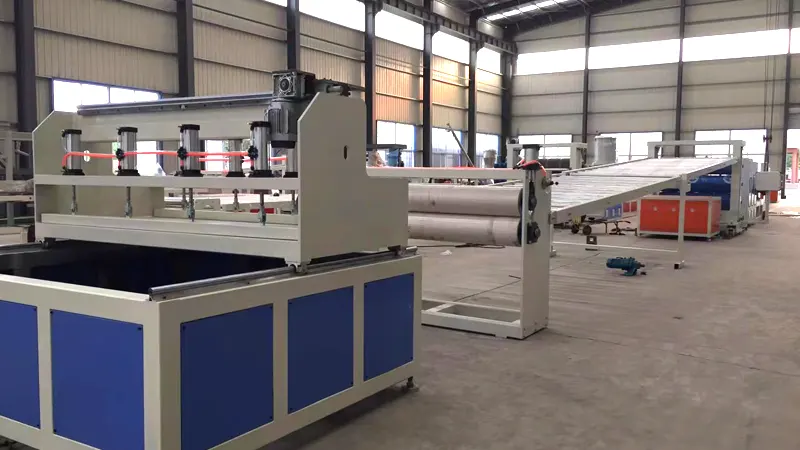
1. Transparent High-Rigidity Packaging Containers (PET/PVC Replacement)
-
Typical products: folding cartons (such as shirt boxes), fruit and berry containers, floral sleeves, and anti-static trays for electronic components.
-
Technical highlights: amorphous PLA grades are used, which are rapidly quenched on chill rolls (roll temperature controlled at 20-30°C) to preserve the polymer chains in a disordered non-crystalline state, yielding high optical clarity with haze values below 5%. Sheet thickness for these applications generally ranges from 0.2 mm to 0.8 mm.
-
Equipment requirements: the PLA Degradable Plastic Sheet Machine must be equipped with mirror-polished chill rolls and enclosed air knives to prevent oxidative yellowing and surface blemishes.
2. Heat-Resistant Foodservice Items (PP/PS Replacement)
-
Typical products: hot beverage lids, microwave-safe meal trays, fast-food clamshells, and heat-resistant soup bowls.
-
Technical highlights: unmodified PLA exhibits poor heat resistance with a Vicat softening point around 55°C, which is insufficient for hot-fill or reheating scenarios. To elevate service temperatures above 100°C, the resin requires compounding with stereocomplex-forming additives (such as PDLA) or post-extrusion orientation and thermal crystallization. Such formulations demand high-shear mixing screw geometries to ensure uniform dispersion of nucleating agents (typically talc or amide-based compounds) that accelerate crystallization kinetics.
-
Equipment requirements: the PLA Degradable Plastic Sheet Machine must incorporate multi-port side-feeders for accurate introduction of these additives directly into the melt stream.
3. Foamed Cushioning Sheet Stock (EPS/EPE Replacement)
-
Typical products: protective inserts for consumer electronics, partition dividers for bottled goods, insulated shipping containers for cold-chain logistics, and single-use shock-absorbing packaging.
-
Technical highlights: the manufacturing process involves injecting physical blowing agents (such as carbon dioxide or butane) into the melt, or compounding chemical blowing agents (azodicarbonamide derivatives) that decompose under controlled temperature and pressure. Upon extrusion through a specialized die lip, the sudden pressure drop initiates bubble nucleation and growth, producing foam sheet with densities ranging from 0.05 g/cm³ to 0.8 g/cm³.
-
Equipment requirements: the PLA Degradable Plastic Sheet Machine must feature dedicated static mixers and melt coolers to maintain dissolution pressures above 15 MPa within the barrel, along with specially profiled die lips designed to prevent premature cell collapse during expansion.
4. Medical-Grade Sterilizable Packaging (PVC Replacement)
-
Typical products: sterile procedure trays for surgical instruments, inner packaging blisters for examination gloves, and base webs for pharmaceutical unit-dose blister packs.
-
Technical highlights: high-purity low-extractable PLA grades are required, capable of withstanding gamma radiation or ethylene oxide (EtO) sterilization cycles without degradation. The extrusion process must incorporate melt filtration systems with absolute filtration precision of 50 µm or finer to eliminate gels, carbonized particulates, and fish-eyes that would compromise optical clarity and barrier integrity.
-
Equipment requirements: the barrel and screw assembly of the PLA Degradable Plastic Sheet Machine require stainless steel or corrosion-resistant linings, and the entire production line must meet cleanroom standards (typically ISO Class 8 / Class 100,000 or higher) to satisfy regulatory compliance for medical device manufacturing.
5. Industrial and Agricultural Functional Sheet Stock (Non-Packaging)
-
Typical products: fully biodegradable agricultural mulching films (in thicker gauges), seedling nursery pots, thermal-transfer printing substrate films, and removable shade panels for greenhouses.
-
Technical highlights: these applications frequently require toughening modifications, achieved through co-extrusion of PLA with PBAT (polybutylene adipate-co-terephthalate) in an A/B/A layered structure, where the internal B-layer provides enhanced tear resistance and flexibility. Sheet thickness ranges widely from 0.5 mm to 3 mm.
-
Equipment requirements: the PLA Degradable Plastic Sheet Machine must be configured with co-extrusion feedblocks or multi-manifold dies (ABA-type distributors), along with on-line thickness gauging systems (either beta-ray or infrared-based) that provide real-time feedback for automatic die-lip profile adjustment.
Equipment Selection Guide (by Product Type and Throughput)
| Product Category | Recommended Extruder Configuration | Screw L/D Ratio | Cooling Method | Winding/Cutting Method |
|---|---|---|---|---|
| High-transparency thin sheet (<0.5mm) | Single-stage vented single-screw extruder | 30:1 - 33:1 | Three-roll polished stack | Fully automatic turret winding |
| Heat-resistant thick sheet (>1mm) | Tandem twin-screw + single-screw | 36:1 and above | Multi-roll cooling carriage | In-line edge trimming + hydraulic guillotine |
| Foamed sheet | Dedicated foam-extrusion single-screw | 34:1 (with mixing section) | Water-ring cooling + sizing calender | Low-tension center winding |
| Multi-layer co-extruded sheet | Multiple extruders in co-extrusion | 30:1 (uniform across all) | Five-roll polishing stack | Servo-driven flying-knife cross-cutting |
Common Product Defects and Process Countermeasures (Practical Guide)
| Defect Observed | Root Cause | Equipment/Process Adjustment |
|---|---|---|
| Surface gel spots / white specks | Inadequate drying (moisture > 500 ppm) | Increase drying temperature to 80-90°C; extend drying time to 4-6 hours |
| Longitudinal thickness fluctuation | Unstable inlet pressure at melt pump | Recalibrate PID matching between screw speed and pull-roll traction |
| Rupture during thermoforming | Insufficient melt strength (molecular degradation) | Reduce rear-zone barrel temperatures; shorten melt residence time |
| Sheet warpage / distortion | Frozen-in orientation stress | Increase chill-roll temperature (limited annealing); add in-line stress-relief unit |
Current development trends in PLA sheet extrusion point toward high-filled formulations incorporating 30% or more calcium carbonate or wood flour to reduce raw-material costs while maintaining acceptable mechanical performance. Fully biodegradable multi-component blends (PLA + PBS + PCL) are gaining traction for applications requiring tailored degradation profiles. Equipment manufacturers are increasingly integrating AI-driven machine vision inspection systems directly into the extrusion line of the PLA Degradable Plastic Sheet Machine, enabling real-time detection of black specks, bubbles, and surface scratches. This advancement has demonstrated measurable quality improvements, elevating first-pass yield rates from approximately 92% to over 98% in commercial production settings, while reducing manual inspection labor and scrap rework.