- English
- Español
- Português
- русский
- Français
- 日本語
- Deutsch
- tiếng Việt
- Italiano
- Nederlands
- ภาษาไทย
- Polski
- 한국어
- Svenska
- magyar
- Malay
- বাংলা ভাষার
- Dansk
- Suomi
- हिन्दी
- Pilipino
- Türkçe
- Gaeilge
- العربية
- Indonesia
- Norsk
- تمل
- český
- ελληνικά
- український
- Javanese
- فارسی
- தமிழ்
- తెలుగు
- नेपाली
- Burmese
- български
- ລາວ
- Latine
- Қазақша
- Euskal
- Azərbaycan
- Slovenský jazyk
- Македонски
- Lietuvos
- Eesti Keel
- Română
- Slovenski
- मराठी
- Srpski језик

Soft Door Curtain Machines: A Practical Guide to Modern Production Line Selection and Operation
The soft PVC door curtain market has seen steady expansion in recent years, driven by growth in cold chain logistics, food processing facilities, warehouse operations, and industrial clean rooms. As demand increases for these versatile barrier products, the machinery used to manufacture them—commonly referred to as soft door curtain machines—has evolved significantly.
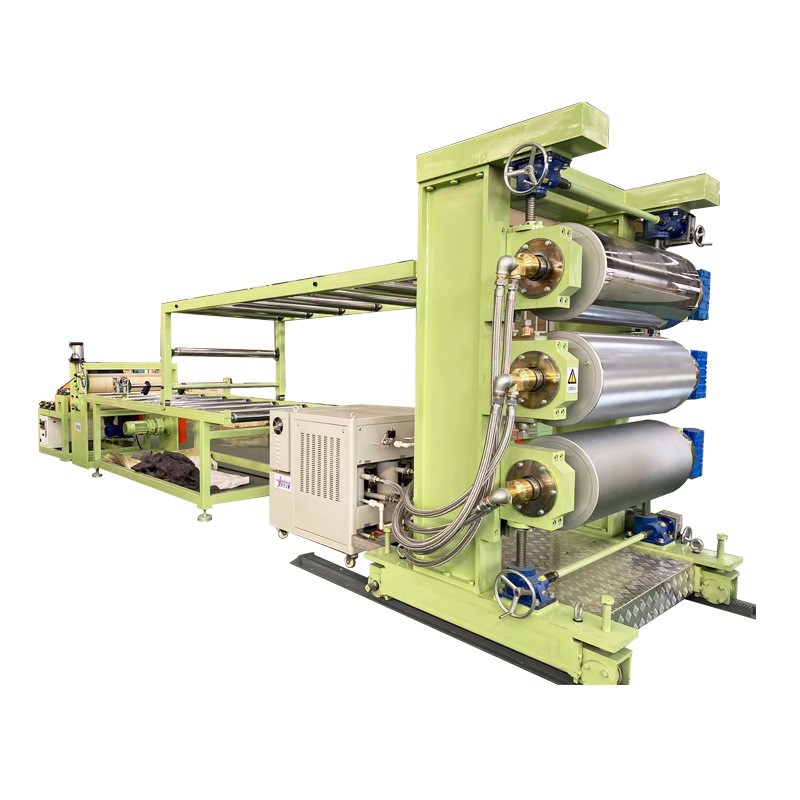
The Shift Toward Continuous Extrusion Lines
Traditional soft door curtain production often followed a fragmented path: extruding sheets in one step, cutting them in another, and then moving to a separate station for hole punching and hardware installation. Each transfer between workstations introduced opportunities for dimensional error and surface damage.
Today, an increasing number of manufacturers are transitioning to continuous extrusion and forming lines that integrate the entire process—from raw material feeding and plasticizing to cooling, pulling, cutting, and even accessory installation—into a single, uninterrupted workflow.
The primary driver of this shift is not simply higher output speeds. In fact, extrusion speeds have not been the main bottleneck for some time. Rather, the decisive factor has become product consistency and dimensional accuracy. A 2.0mm thick transparent curtain that varies by more than ±0.1mm across its length will hang unevenly and fail to seal properly at the bottom. Continuous production lines address this by synchronizing puller speed with extruder output through closed-loop control, maintaining tight thickness tolerances throughout long production runs.
Critical Quality Control Points: Cooling and Cutting
In any soft door curtain extrusion line, two stages have an outsized impact on final product quality and yield rates.
Cooling Section Management
When molten PVC exits the die, it is still at an elevated temperature. Rapid or uneven cooling can trap internal stresses within the material, leading to warping, surface ripples, or curling at the edges after the curtain is installed.
Modern lines typically employ a staged cooling approach:
-
A warm-water bath for initial gradual cooling
-
A cold-water bath for final setting
-
Air knives at the exit to remove surface moisture before winding
This staged method reduces thermal shock and yields a flatter, more dimensionally stable product. The water circulation system should also include filtration to remove impurities; particles as small as 50μm can become embedded in the soft PVC surface and render the entire length unsellable.
Cutting Mechanism Selection
Soft PVC presents a particular challenge during cutting. Rotary blades operate quickly but generate heat through friction, which can cause slight melting or fusing at the cut edge. This melted edge often becomes the weak point where mounting rings are later attached, leading to premature tearing during installation or use.
For this reason, many production lines opt for shear-type cutting or pneumatic cold cutting mechanisms. These methods preserve edge integrity with a clean, slightly matte finish, even if they operate at somewhat lower cycle speeds compared to rotary cutters. Experienced operators adjust cutting parameters based on the thickness and hardness of each production batch rather than running a single setting for all orders.
Recipe Flexibility: Handling Diverse Application Requirements
Soft door curtains are not one-size-fits-all products. Different end-use environments demand different material formulations:
| Application | Key Formulation Requirement |
|---|---|
| Cold storage / freezer rooms | Low-temperature resistance (down to -20°C without cracking or hardening) |
| Food processing facilities | Compliance with food-contact material standards; colors limited to transparent or blue for visual inspection |
| Logistics corridors / forklift traffic | Enhanced impact resistance; sometimes with reinforced layers or anti-rip additives |
| Clean rooms / electronics manufacturing | Anti-static properties; tightly controlled surface smoothness |
A production line that can only process one standard formulation will struggle to serve multiple customer segments. Equipment with side-fed auxiliary metering ports allows operators to introduce additives or adjust the masterbatch ratio without stopping the line. Combined with a control system that can store multiple recipe profiles, this capability enables recipe switching in under 20 minutes—a significant advantage for job shops handling diverse orders.
Accessory Installation Integration: Reducing Post-Processing Overhead
The finished curtain sheet is not ready for installation until mounting holes have been punched and metal rings or hangers have been attached. Historically, this has been a manual secondary operation, requiring handling, alignment, and punching one hole at a time. This approach suffers from several inherent drawbacks:
-
Inconsistent hole positioning from piece to piece
-
Risk of surface scratches during handling
-
Labor-intensive and repetitive work
Forward-thinking equipment manufacturers have addressed this by integrating automatic hole-punching and ring-insertion stations directly into the end of the extrusion line. The system punches accurately positioned oval slots and inserts metal mounting rings—fed from a vibratory bowl—before the final cut-to-length operation. Facilities that have adopted this integrated approach report a reduction of up to 60% in manual labor for post-processing, along with near-elimination of handling-related rejects.
Practical Selection Criteria for Buyers
If you are evaluating soft door curtain machine options for a new facility or an upgrade, here are several technical aspects worth close examination:
Pull Roller Configuration
The material and pressure adjustment mechanism of the pull rollers directly affects surface quality. Rubber-coated rollers paired with steel counter-rollers provide better grip without marking the PVC surface. Pay attention to whether the pressure can be adjusted independently at each end to accommodate slight thickness variations.
Cutting Blade Accessibility
Quick-change blade holders can reduce downtime significantly. Some designs allow blade replacement in under five minutes without specialized tools. This seemingly minor detail has a direct impact on overall equipment effectiveness (OEE) over time.
Water Circulation and Filtration
Closed-loop water systems with integrated filtration help maintain consistent cooling conditions and prevent contamination. Ensure the filtration system is easily accessible for cleaning and that replacement filter media are readily available.
Control System and Data Logging
Modern systems should offer recipe storage, production counters, and alarm history. Perhaps more importantly, the system should support export of process data—temperature profiles, line speed, pressure readings—for quality traceability and process optimization. This becomes critical when responding to customer complaints or conducting internal audits.
Operational Best Practices
Even the most well-engineered line requires disciplined operation to deliver consistent results. Three practices stand out in well-run facilities:
1. Pre-start verification. Before each shift, check water temperature, cooling levels, and the condition of cutting blades. Small variations compound over an eight-hour run.
2. Ongoing dimensional monitoring. Measure thickness and width at regular intervals—every 100 to 200 meters is a common cadence. Early detection of drift allows adjustment before significant scrap accumulates.
3. Scheduled maintenance discipline. Replace pull roller bearings and clean cooling tanks according to the manufacturer's schedule, not only when problems appear. Soft PVC residues build up gradually and affect performance long before they become visible.
Soft door curtain machines are not among the most technologically exotic pieces of industrial equipment—but the gap between a good line and a great one lies entirely in attention to stability and detail. In a market where demand remains fundamentally healthy but competition grows tighter, the competitive edge increasingly belongs to operations that achieve lower downtime, faster changeovers, less scrap, and better product consistency.
These advantages do not come from any single feature. They come from the cumulative effect of well-chosen components, thoughtful integration, and disciplined operating practices. For manufacturers looking to build or expand their capacity, focusing on these fundamentals offers a more reliable path to profitability than chasing the highest possible line speed alone.